⚙️ Modules
z-shell/zpmod
- Required Zsh version: >= v5.8.1


The module is a binary Zsh module transparently and automatically compiles sourced scripts and measures the time of each script sourcing.
source file -> freshness check -> compile or reuse .zwc -> execute -> source-study report
zpmod also provides native builtins for batch path metadata, directory listing, file reading, and record-oriented array input. These helpers reduce repeated shell-level filesystem work without requiring a particular plugin manager.
Measuring Time of sources
zpmod source-study [-l]
Option -l shows full paths to the files.
Issue zpmod source-study after loading the module at top of ~/.zshrc to see a list of files loaded via source or . builtins, with a duration that each loading lasted, in milliseconds. The module tracks all calls to those builtins and measures the time each call took. This can be used e.g. profile loading of plugins, regardless of the plugin manager used.
This feature allows profiling the shell startup. Also, no script can pass through that check and you will obtain a complete list of all loaded scripts, like if Zshell itself was investigating this.
The list can be surprising 😵💫
⏱️    3 ms    plugin-a.plugin.zsh
⏱️   12 ms    plugin-b.plugin.zsh
The values above illustrate the report format. Actual timings depend on the machine and shell configuration.
Reproducible benchmark
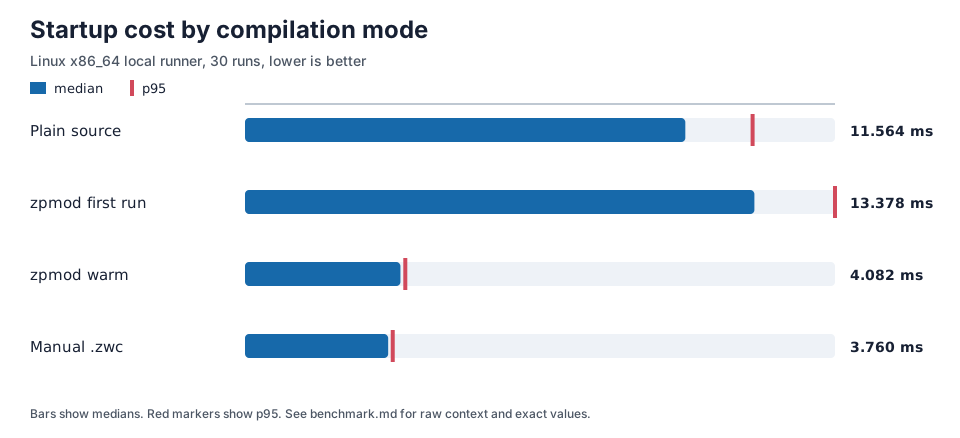
| Mode | Median | p95 |
|---|---|---|
| Plain source | 11.564 ms | 13.331 ms |
| zpmod first run | 13.378 ms | 15.495 ms |
| zpmod warm | 4.082 ms | 4.210 ms |
Manual .zwc | 3.760 ms | 3.880 ms |
The v2.0.6 comparison uses one synthetic 40-script workload. The first run includes compilation, the warm run reuses generated .zwc
files, and manual .zwc is the native Zsh control. It is not a universal startup-speed claim. Read the complete benchmark report and
benchmark methodology for the raw context and reproduction commands.
Extending Zi reports
zpmod <report-append> [options]
Used by zpmod internally to speed up loading plugins with tracking (reporting). It extends the given field {plugin-ID} in $ZI_REPORTS hash, with the given string {new-report-body}.
Debugging
To enable debug messages from the module set:
typeset -g ZI_MOD_DEBUG=1
Install zpmod
- Zi
- Standalone
- To start using the module run:
zi module -B, append--cleanto runmake distclean. - To display the instructions on loading the module, run:
zi module -I.
zi module [-B|--build[--clean]] [-I|--info] [-r|--reset] [-h|--help] [options]
zi module -B [--clean]  # Build the module, append --clean to run distclean.
zi module -I            # Display instructions on loading the module.
zi module -r            # Check timestamps and rebuild the module if needed.
This command will compile the module and display instructions on what to add to ~/.zshrc.
Install zpmod as a system package or build it with the repository's CMake helper. Both paths work without Zi or another plugin manager. See the current standalone installation guide.
z-shell/zgdbm
Provides GDBM module as a plugin.
zstyles - The values being set are the defaults.
Change the values before loading the zgdbm plugin.
zstyle ":plugin:zgdbm" cppflags "-I/usr/local/include"  # Additional include directory
zstyle ":plugin:zgdbm" cflags "-Wall -O2 -g"            # Additional CFLAGS
zstyle ":plugin:zgdbm" ldflags "-L/usr/local/lib"       # Additional library directory
Install zgdbm
zi light z-shell/zgdbm